





















Kitchens
- Category Name
- Kitchens


Speak to our design professionals
Share your info, we’ll book your slot.
Get tailored made designs from our interior design services by asian paints.
Will you be living in your space during the renovation?
 Previous Question
Previous Question
Previous Question
Please Select Date and Day
Appointment Date & time


Choosing the perfect upholstery fabric can make all the difference in comfort and style for your home. With so many options available, it’s important to find a material that fits your lifestyle and décor seamlessly
Choosing sofa fabric is one of those decisions that seems simple until you're living with the consequences. You wanted velvet, you got velvet, and now it's July, and you're stuck to your sofa like a very unhappy stamp. Or you went with light linen, and your toddler decided it was a canvas for a mango-based art project.
Indian homes have specific demands that most international upholstery guides simply don't account for: real summer heat, a serious monsoon, enthusiastic cooking odours that permeate everything, pets, children, grandparents, and guests who actually sit on the furniture. Here's what you need to know before you commit.
• What is Upholstery and How does it Affect Your Furniture
• Types of Upholstery Fabrics Available in India
• How Indian Climate Affects Upholstery Fabric Choice
• Upholstery Fabric Guide by Furniture Type
• Upholstery Fabric Guide by Household Situation
• How to Choose Upholstery Fabric: Key Evaluation Criteria
• Upholstery Fabric Trends for Indian Homes in 2026
• Upholstery Reupholstering: When to Refabric Instead of Replace
• Where to Buy Upholstery Fabric in India
• Frequently Asked Questions About Upholstery Fabric in India
Upholstery is the fabric (and the padding and support system beneath it) that determines how your furniture feels to sit on, how it looks in the room, and how long it stays looking good. The right upholstery fabric protects the furniture frame, adds comfort, and does significant decorative work in a room. The wrong one gets ruined in a season.
A sofa fabric choice is one of the most significant design decisions in a living room. The colour, texture, pattern, and sheen of your sofa fabric influence the temperature of the room (warm or cool), its visual weight, and the overall style it communicates. A plush velvet sofa reads luxury. A linen sofa reads casual-contemporary. A leather sofa reads structured and slightly formal. The fabric is doing a lot of work.
Upholstery is permanent; the fabric is fitted and secured to the furniture frame. Slipcovers are removable fabric covers that slip over an existing sofa, are washable, interchangeable, and practical for homes with heavy use or young children. The trade-off is that slipcovers rarely look as tailored or sophisticated as proper upholstery.
Cotton is breathable, washable in lighter weights, and affordable. It handles Indian summers better than most synthetic alternatives. The downsides: it wrinkles, fades in strong sunlight, and isn't particularly durable under heavy use. For a casual aesthetic in a moderate-use room, cotton upholstery fabric works well.
Linen has a beautiful texture, ages well, and is among the most breathable natural upholstery options. It suits contemporary and coastal Indian interiors particularly well. The practical catch: it wrinkles easily, stains without treatment, and doesn't love pets or active children. Pre-treated with a stain-resistant finish is a sensible upgrade.
Velvet is the fabric equivalent of turning up the volume. Rich, tactile, and visually luxurious, one of the most popular sofa fabric choices in premium Indian interiors. The concern about velvet in India isn't entirely unfounded: it does retain heat. But performance velvet (polyester-based rather than pure silk or cotton velvet) is significantly more practical, durable, cleanable, and breathable than traditional velvet. From October to February, it's genuinely comfortable. For summer, put a muslin throw on it and call it a day.
Leather is durable, easy to wipe clean, and has an authoritative quality that works well in more formal living rooms and home offices. In Indian heat, it can feel warm and sticky; good ventilation or air conditioning makes a real difference to the experience. Faux leather (PU leather) has improved dramatically in quality and is a viable budget option; look for versions with a fabric backing for better breathability.
Polyester blends fabric are the workhorses of the upholstery world. Durable, fade-resistant, relatively affordable, and available in an enormous range of textures and colours, including convincing mimics of linen, velvet, and woven textures. For high-traffic sofas and children's furniture, a well-chosen polyester blend is a practical first choice.
Microfibre deserves more credit than it gets. Extremely durable, resists stains better than most natural fabrics, and the suede-like varieties have a soft, premium feel that surprises people who associate the material with budget office chairs. For homes with pets and children, where the sofa fabric is tested daily, microfibre is one of the most sensible choices available.
Silk and brocade are not sofa fabrics for everyday use. They're for accent chairs, occasional chairs, and headboards in master bedrooms, pieces that are admired more than used. In these contexts, they're spectacular. Just don't let anyone eat on them.
For balcony furniture, outdoor seating, and any furniture in rooms with significant moisture exposure, solution-dyed acrylic fabrics or high-performance polyester weaves are designed specifically for the conditions, UV-resistant, mold-resistant, and washable.
Natural fibres (cotton, linen) breathe better than synthetic ones. Open-weave fabrics breathe better than tight-weave ones. In rooms without air conditioning, breathability is a genuine comfort criterion, not just a marketing term. Velvet, faux leather, and tight synthetic weaves retain more heat against the body than cotton, linen, or open-weave alternatives.
Prolonged high humidity creates conditions where upholstery fabric can develop mold, particularly if the furniture is against a damp or poorly ventilated wall. Synthetic fabrics are generally more resistant to mold than natural ones. Airing upholstered furniture in sunlight periodically during and after the monsoon is a good maintenance practice.
Textured, pile fabrics (velvet, boucle, chenille) trap dust more than smooth ones. Tight-weave or smooth-surface fabrics are easier to dust and vacuum. In cities with high ambient dust levels, which is most Indian cities, this is worth factoring in.
Sunlight fades upholstery fabric faster than most homeowners anticipate, particularly natural fibres and rich dyes. Solution-dyed acrylic and high-quality polyester blends retain colour significantly longer. If your sofa sits in direct sunlight for part of the day, a UV-stable fabric or UV-filtering window treatments are advisable.
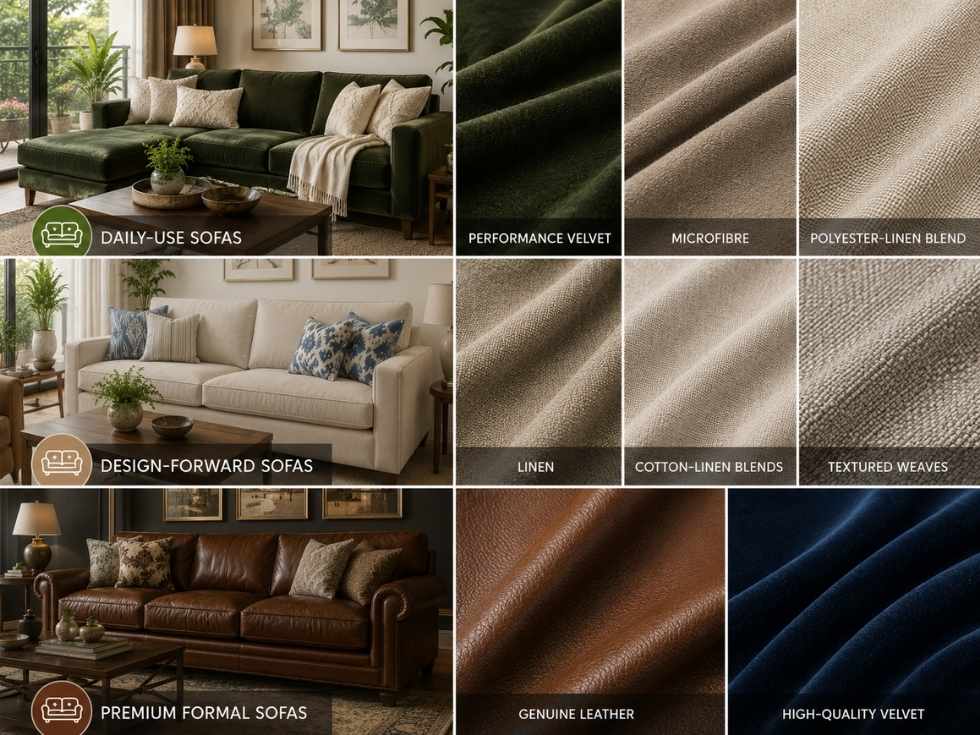
For daily-use sofas: performance velvet, microfibre, or a mid-weight polyester-linen blend. For design-forward sofas in rooms with moderate use: linen, cotton-linen blends, or textured weaves. For premium formal sofas: genuine leather or high-quality velvet with a strong backing.
Dining chairs get food on them. This is not a hypothetical. Choose fabrics that wipe clean easily: faux leather, treated polyester, microfibre, or performance fabrics. If you want the look of linen on dining chairs (and it's a beautiful look), use a pre-treated or stain-resistant version.
Headboards are primarily decorative; they're leaned against occasionally, but don't take the sustained use a sofa does. This makes them the right place for more delicate or premium fabrics: boucle, velvet, brocade, or a textured linen. They're also where you can use lighter or more fashion-forward colours, since UV exposure in most bedrooms is lower than in living rooms.
Accent chairs are statement pieces; the fabric should be interesting. Pattern, texture, a bold colour, or a premium material. Brocade, patterned velvet, woven cotton, and silk blends all work well for chairs that are used occasionally but seen constantly.
Practicality first: breathability (you're sitting for hours), durability (daily use), and ease of cleaning. Mesh and performance fabrics are standard in task chairs. For lounge or occasional seating in a home office, microfibre or a tight-weave polyester blend is a sensible choice.
Microfibre, performance velvet, treated polyester, and faux leather. Avoid light colours, silk, untreated linen, and open-weave fabrics. The question to ask: "How will this look after a mango lassi incident?" If the answer is "terrible," pick something else.
Tight-weave fabrics that resist claw snags, microfibre, canvas-weight cotton, leather, and performance fabrics. Avoid velvet (pet hair embeds in the pile and is genuinely difficult to remove) and open weaves (claws go through them). Dark or patterned fabrics are more forgiving of fur.
Easy-to-clean fabrics that don't trap allergens: tight-weave synthetics, leather, and microfibre. Avoid pile fabrics and fabrics that are difficult to vacuum thoroughly.
Durable, dark or patterned, easy to clean, and unfussy. Performance polyester, faux leather, and microfibre tick all these boxes. Neutral colours reduce the risk of clashing with tenants' existing décor.
The Martindale test measures how many back-and-forth rub cycles a fabric can withstand before showing visible wear. For a domestic sofa used daily, look for a Martindale score of at least 25,000. Heavy-use sofas benefit from 40,000+. Fabrics with scores below 15,000 are for light-use or decorative applications only. When buying, ask for the Martindale score; any quality supplier will provide it.
Ask specifically: "What happens if red wine lands on this fabric?" The answer will tell you most of what you need to know. Some fabrics have factory-applied stain-resistant treatments; others are inherently easy to clean by virtue of their surface.
Sit on it. Fabric that looks beautiful in a showroom but feels rough or hot against bare skin is not the right choice for a daily-use sofa. Texture is not just aesthetic, it's the thing you'll actually experience every day.
Darker colours and patterns disguise wear and minor soiling better than pale solids. All colours fade over time; solution-dyed fabrics and those with strong colourfast ratings hold their colour longer.
Use the room's existing palette as a starting point. The sofa fabric doesn't need to match; it needs to coordinate. Pick up one colour from the room's palette for the sofa fabric, and introduce texture or pattern as the variable.
Terracotta, sand, warm taupe, ochre, the earthy palette that dominated interior design through 2024–25 has settled into a sustained preference rather than a passing trend. These tones work with natural wood furniture, rattan, and botanical elements, and they age gracefully.
Bouclé, the looped, nubby-textured woven fabric, has been having an extended moment in Indian interior design. It has a tactile warmth that photographs beautifully and works across contemporary and mid-century-inspired interiors. Performance bouclé variants are now available that offer the aesthetic without the vulnerability of traditional loose weaves.
The line between "practical" and "beautiful" in upholstery fabric has genuinely blurred. Performance velvets, treated linens, and solution-dyed weaves now look as good as their delicate counterparts while handling real-life conditions significantly better. For Indian homes, this is the category most worth exploring.
Recycled polyester, organic cotton, and responsibly sourced natural fibres are now widely available in the Indian upholstery market. These options have improved considerably in quality and aesthetic range for homeowners conscious of environmental impact.
The fabric is worn through, faded significantly, or structurally damaged. The foam or padding has compressed, and seating comfort has deteriorated. The style no longer works with the room's décor. Any of these is a reason to reupholster rather than replace, particularly for solid, well-made furniture frames that are structurally sound.
A standard three-seater sofa reupholstered in a mid-range fabric typically costs ₹8,000–₹20,000, depending on the city, fabric choice, and whether the foam needs replacement. Accent chairs range from ₹2,000 to ₹8,000. Compare this to the cost of a replacement sofa of equivalent quality before assuming replacement is more economical, it often isn't.
Ask for referrals from interior designers or furniture retailers. Look for upholsterers who will show previous work. Insist on seeing and approving a fabric sample on the actual piece before full application begins. A good upholsterer will ask about usage, sun exposure, and cleaning preferences before recommending a fabric; if they don't, that's information.
Beautiful Homes by Asian Paints offers a curated range of upholstery and furnishing fabrics for home interiors. Always order samples before committing; texture and colour don't translate accurately on screen.
Mumbai's Bhuleshwar and Dharavi fabric markets. Delhi's Chandni Chowk and the commercial areas around the Kirti Nagar furniture market. Bangalore's Commercial Street. Chennai's T. Nagar. These markets carry a vast range of upholstery fabrics at competitive prices. Bring physical swatches of your room's existing colours and a note of the Martindale rating you need.
Martindale score. Colourfastness rating. Whether it has stain-resistant treatment. Whether it's pre-shrunk. Cleaning instructions. Roll width. And, always, take it to the actual room, in the actual lighting, alongside the actual existing furniture, before purchasing. Fabric that looks perfect in a shop under fluorescent light often tells a different story at home.
Microfibre and performance velvet top the list for active family homes. Both resist stains well, clean with a lightly damp cloth, and don't show wear as quickly as natural fabrics. Treated polyester blends are a close third.
Fabric (particularly breathable natural or performance fabrics) is generally more comfortable in Indian heat. Leather has superior durability and ease of cleaning, but can feel warm in un-air-conditioned rooms. Leather is better for homes with consistent air conditioning; fabric is more forgiving across the range of Indian climate conditions.
A good-quality upholstery fabric on a well-made sofa, used daily, typically lasts seven to twelve years before showing significant wear. Higher Martindale ratings, quality foam support, and rotating cushions extend this considerably.
Yes, Scotchgard and equivalent fabric protection sprays can be applied to most fabrics. They don't make fabric impervious, but they significantly extend the time available to blot and clean a spill before it sets. Reapplication is needed every one to two years.
Upholstery grade fabric is constructed to withstand the mechanical stress of regular seating use, the rubbing, pulling, and compression cycles that a sofa seat receives. Regular fabric (dress or curtain fabric) isn't constructed for this and will wear through quickly when used for upholstery. The Martindale score is the measurable difference.
Simple shapes (a dining chair seat pad, a stool, an ottoman) are well within DIY territory. A full sofa, with its compound curves, multiple layers, and structural elements, benefits significantly from professional work. The difference in result is significant.
A standard three-seater sofa typically requires 8–12 metres of upholstery fabric (at 140cm width), depending on design complexity and pattern repeat. Ask your upholsterer for a precise measurement before purchasing. Buying short is an expensive mistake when matching a pattern or dye lot.
Drop your info and we will call you to book your preferred consultation slot our experts will reach out to you.
Yes, I would like to receive important updates and notifications on WhatsApp.
By proceeding, I authorize Asian Paints Limited and its authorized contractors/partners to contact me via WhatsApp, phone calls, SMS and e-mail and I agree to the Terms & Conditions and Privacy Policy.
Our team will contact you for further details.
We were unable to receive your details. Please try submitting them again.


