




Kitchens
- Category Name
- Kitchens


Speak to our design professionals
Share your info, we’ll book your slot.
Get tailored made designs from our interior design services by asian paints.
Will you be living in your space during the renovation?
 Previous Question
Previous Question
Previous Question
Please Select Date and Day
Appointment Date & time


Blurring the boundary between the engineered and the grown, Solarpunk imagines cities as ecosystems and design as a tool for repair, resilience, and renewed collective possibility
If the early 21st century was defined by climate anxiety and dystopian imagination, Solarpunk emerges as its counter-proposal: a cultural movement grounded in defiant, actionable hope. Where collapse narratives once dominated, Solarpunk reframes the future not as a site of inevitable decline but as a landscape for repair, resilience, and renewal. It asks a simple but radical question: what if the future were not something to survive, but something to redesign?
This direction aligns closely with cultural theorist Mark Fisher’s call for a “post-capitalist desire”—the ability to imagine systems beyond extractive inevitability. For decades, it seemed easier to picture ecological ruin than systemic transformation. Solarpunk disrupts that paralysis by insisting that we can desire differently. That progress need not be synonymous with depletion. That innovation can be ecological, equitable, and joyful rather than austere and sacrificial.
At its core, Solarpunk reframes the relationship between humans, technology, and nature. It positions nature not as a passive resource to be consumed, nor merely a fragile entity to be protected, but as an active collaborator. A co-designer within an interconnected system. In this worldview, ecosystems, materials science, and digital technologies form a symbiotic triad. Innovation here means enhancing and regenerating with the natural world rather than overriding it.
Solar Punk emerges from exhaustion with climate doomerism. For over a decade, environmental discourse oscillated between apocalyptic imagery and incremental action messaging. The emotional toll of constant alarm has given rise to a hunger for constructive optimism where solutions feel tangible, scalable, and grounded in imagination rather than fear. Another reason is the rise of regenerative design. Architectural discourse has shifted from “sustainability” (reducing harm) toward regeneration (actively restoring systems). The 2025 Venice Architecture Biennale foregrounded precisely this triangulation of human intelligence, technological advancement, and the powers of nature. Projects such as Diller Scofidio + Renfro’s Canal Café—an experimental espresso bar converting lagoon water into purified drinking water—illustrated design not as commentary, but as intervention.
Biofabrication labs, material science studios together with research institutions are increasingly collaborating with designers. Hempcrete housing systems, algae-based facades, mycelium composites, and adaptive shading technologies demonstrate that architecture can operate as an ecosystem rather than enclosure. Aesthetic shifts in fashion and lifestyle culture reflect the same ethos. The rise of gorpcore—even within luxury houses—signals a new admiration for high-performance materials and outdoor readiness. On Autumn/Winter 2025 runways, Louis Vuitton’s ski-inflected silhouettes, Sacai’s gear-laden ensembles, and Kiko Kostadinov’s technical outerwear blurred the boundary between survival equipment and couture. Parallel to this, survivalist gaming cultures and immersive world-building reflect an appetite for speculative futures where players rebuild ecosystems and engineer solutions. The desire is no longer merely to critique dystopia, but to prototype alternatives.
Aesthetically, Solarpunk is both engineered and organic. Biomorphic forms curve and adapt, echoing leaf structures, coral growth, and skeletal systems. Exoskeletal architectures expose structural truth rather than conceal it. Materials appear craggy, rough-cut, undone as a way of celebrating imperfection as evidence of process.
Technologies such as 3D-printed mycelium by bioMATTERS merge microbiology with computational design, transforming microbial intelligence into structural material. Nike’s ISPA philosophy—Improvise, Scavenge, Protect, Adapt—encapsulates this adaptive logic, engineering performance wear that anticipates environmental uncertainty. GORE-TEX® innovations demonstrate a sense of resilience without rigidity. Even decorative objects embody this hybrid logic. Plant-dyed aluminium lamps allow organic pigment to imprint industrial metal, creating surfaces that feel both engineered and grown. In this context, deconstruction becomes a form of reconstruction, as slag-based concrete reimagines industrial waste not as residue, but as a viable and expressive architectural possibility.
Solarpunk’s visual language often carries a quality of strangeness, though not in a dystopian sense; rather, it feels unfamiliar because it imagines a world no longer confined by the limitations of the present. In these speculative landscapes, cities appear to breathe, infrastructure integrates with ecosystems, and materials are designed to regenerate rather than deplete. Collage-like compositions layer vegetation with circuitry, solar panels with climbing vines, and metallic surfaces softened by moss, creating hybrid environments where technological and natural systems are inseparable.
In this context, biophilic design evolves beyond the simple gesture of bringing plants indoors. It becomes an embedded intelligence, where living systems actively shape material innovation and spatial thinking, dissolving the boundary between what is engineered and what is grown.
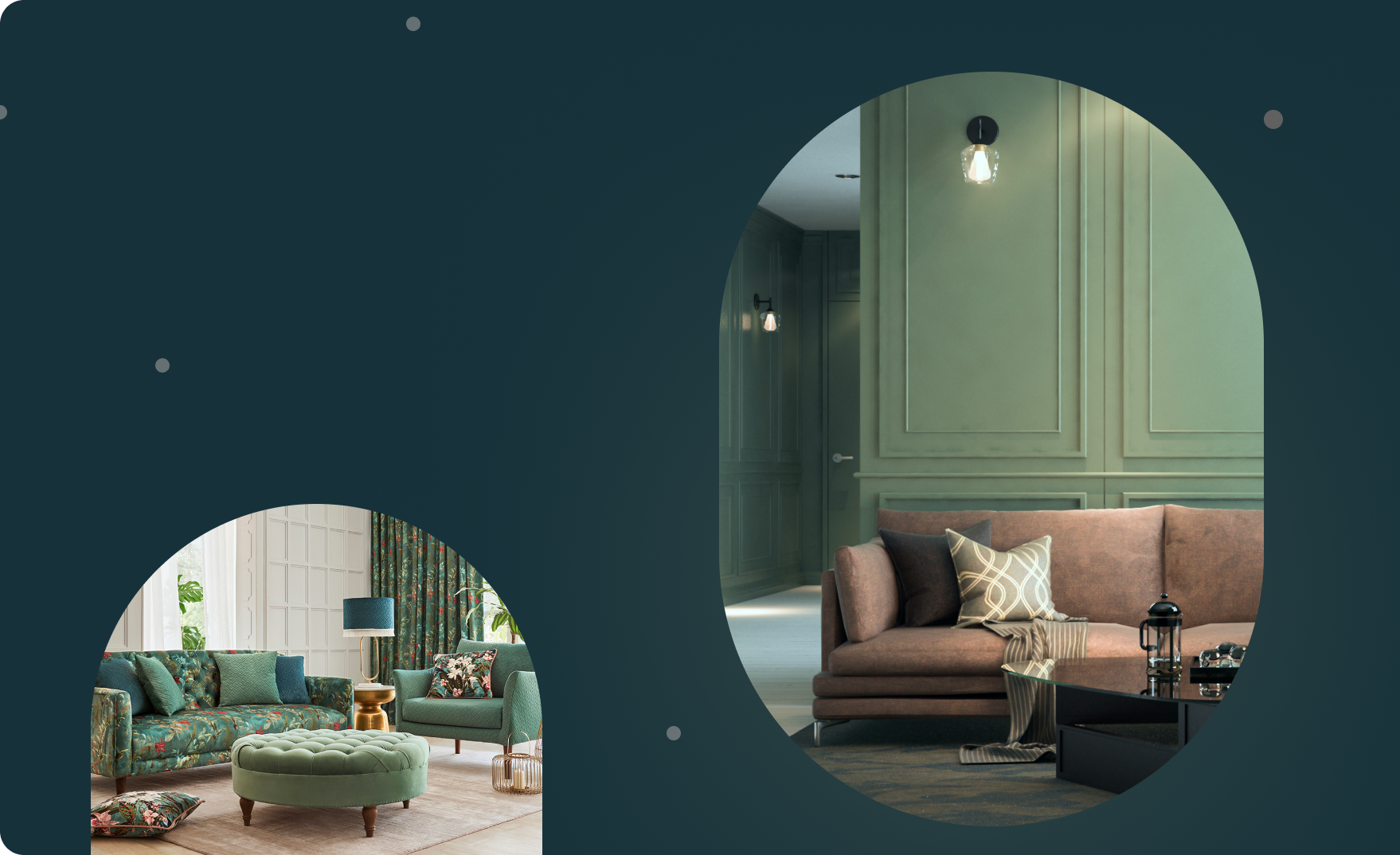
Solar Punk’s colour language reflects this symbiotic ethos through balanced, mid-contrast harmonies that feel at once grounded and forward-facing. These hues articulate a form of ecological optimism that is measured rather than naïve. They avoid nostalgia as much as they resist techno-sterility, suggesting durability without visual weight and innovation without alienation. The palette carries a subtle strangeness, yet remains deeply tangible, offering a chromatic blueprint for futures that feel not only imaginable, but genuinely inhabitable.
Where sustainability once asked us to reduce, Solarpunk invites us to redesign. Where environmental discourse focused on guilt, Solarpunk foregrounds agency. It recognises that imagination is infrastructural—that what we can picture influences what we build. In design practice, this manifests as cross-disciplinary collaboration. Architects consult biologists. Fashion designers experiment with lab-grown fibres. Urban planners consider micro-ecosystems within city grids. Material labs function as research hubs rather than production pipelines.
In this sense, Solarpunk shares a deep affinity with immersive media culture, particularly in its belief that environments are not passive backdrops but active agents capable of shaping collective imagination. Within this framework, space is understood as a catalyst for change rather than a neutral container for activity. Architecture begins to operate as a collaborator with wind, light and water, responding to and evolving with natural forces instead of resisting them. Likewise, products are conceived not as disposable objects destined for rapid obsolescence, but as adaptive systems designed to evolve over time, anticipating repair, modification, and continued use as integral aspects of their lifecycle.
If IRL calls us back to presence and Pastoral roots us in lineage, Solarpunk projects us toward regenerative possibility. It acknowledges the fragility of our systems while refusing fatalism. It insists that the future is not cancelled, but actively under construction. By imagining systems of repair rather than collapse, Solarpunk performs a profound cultural act of optimism, reframing crisis as a site of possibility. It encourages us to look beyond what we fear losing and instead consider what we are capable of building together. In doing so, it translates climate anxiety into design intelligence, transforming uncertainty into a catalyst for innovation, collaboration, and renewed collective agency.
Drop your info and we will call you to book your preferred consultation slot our experts will reach out to you.
Yes, I would like to receive important updates and notifications on WhatsApp.
By proceeding, I authorize Asian Paints Limited and its authorized contractors/partners to contact me via WhatsApp, phone calls, SMS and e-mail and I agree to the Terms & Conditions and Privacy Policy.
We've received your details.
Our Beautiful Homes expert will connect with you shortly.
We were unable to receive your details.
Please try submitting them again.


