



















Kitchens
- Category Name
- Kitchens


Speak to our design professionals
Share your info, we’ll book your slot.
Get tailored made designs from our interior design services by asian paints.
Will you be living in your space during the renovation?
 Previous Question
Previous Question
Previous Question
Please Select Date and Day
Appointment Date & time


High above Bandra, with sweeping views of the Bandra-Worli Sea Link, Sonakshi Sinha and Zaheer Iqbal’s first home together is a study in comfort, contrast and joy that spills easily from room to room
Hindi film actors Sonakshi Sinha and Zaheer Iqbal have spent years living out of suitcases. Between film sets, hotel rooms and temporary bases across cities, the rhythm of their lives has always been on the move. Which is perhaps why this home, perched high above Bandra with uninterrupted views of the Bandra-Worli Sea Link and the downtown skyline, feels so decisively settled. It’s their first home together and it’s been imagined as a place they return to, rather than pass through.
“Home is where I can just be myself,” Sonakshi says early on in our tour of her home and the house reflects that ease almost immediately. You step into a large, open living space where light pours in through tall glass windows with the city never quite leaving your line of sight. The layout keeps everyone within sight and earshot, something both of them talk about often during our tour of their home. It’s a quality Zaheer and Sonakshi associate with the homes they grew up in, where you always knew who was around and what was happening, even if you were in different rooms.
As you move through the home, it becomes clear that this openness also allows for contrast. The house is loosely divided into two moods. One half is what Sonakshi jokingly refers to as the “Maldives side” with rounded forms, earthy finishes and an almost resort-like, boho-chic vibe. The other, influenced by Zaheer’s taste, has a sharper, more urban mood. Glass partitions, concrete surfaces and cleaner lines give this “New York side” its loft-like character. It mirrors the couple themselves who are similar in spirit but different in temperament.
Throughout the tour, Sonakshi and Zaheer interrupt each other mid-sentence, finish each other’s thoughts and keep breaking into jokes as they move from room to room. At one point, when asked what the house would say if it could speak, the answer comes without hesitation – it would tell them to stop laughing because its jaw hurts. It’s a joke that works because it feels so true. This is a home built on sound as much as sight with voices carrying across rooms and the comfort of knowing where everyone is at all times.
Sonakshi Sinha and Zaheer Iqbal’s luxurious Bandra penthouse offers practical lessons in designing a home that accommodates two distinct tastes while still feeling cohesive and comfortable. The details that make it work are worth paying attention to:
Instead of assigning rooms rigid functions, think about how different personalities and energies can coexist within the same floorplan . In this home, the contrast between the sharper, more urban “New York side” and the softer, more relaxed “Maldives side” is created through material choices, furniture language and colour, instead of solid barriers. Rounded furniture meets strong architectural lines while macramé and expressive lighting soften the use of concrete and glass. See-through partitions, changes in flooring or shifts in palette can subtly signal a change in mood while keeping the house visually connected. It’s an intelligent way to design a home cohesively for distinct personalities.
Pro Tip: If you’re designing for two people with different tastes, agree on a shared base palette first. Once that’s locked, allow individual spaces to diverge through texture, form or secondary colours. This prevents visual chaos while still feeling personal. Soft, grounding shades like Asian Paints’ 7691 Tree of Life, 7563 Dawn of Spring, L135 Sahara Dream and K130 Badal work well as a common base. They are calm enough to unify a home, yet flexible enough to support contrasting styles.
The penthouse is expansive and plush but not too formal. Furniture is low and deep, arranged for lounging rather than symmetry. Sonakshi and Zaheer’s brief to their designer was simple – everything had to be sturdy, solid and easy to live with. This approach removes the anxiety that often comes with “done” homes, where guests hesitate and hosts hover. A home feels more generous when guests don’t feel the need to ask where they’re allowed to sit or what they should avoid touching. But prioritising durability doesn’t mean sacrificing aesthetics. It simply shifts the focus to materials that age well and invite everyday use.
Upholstery and cushion covers lean towards linen blends, cotton-linen mixes and textured weaves that breathe well and soften with use, rather than showing wear too quickly. Fabrics such as those from the Dori Linen collection by The Pure Concept for Nilaya, woven from fine flax-spun yarns and offered in deeper, forgiving shades are well suited to everyday living.
Pro Tip: When choosing furniture, ask how it will look after five years, not five months. Scratches, patina and wear should add character rather than signal damage, especially in areas of the home designed for hosting. Solid wood furniture finished with durable treatments such as Asian Paints Woodtech Emporio Gold Ultra Luxury Wood Finish, ages better over time, developing depth and richness instead of looking tired.
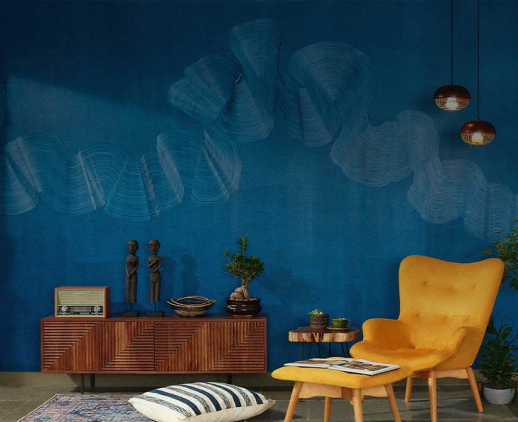
The blue wall in the apartment’s den, painted in Asian Paints’ ‘Twilight Zone’, has a story of its own. Inspired by the same shade in actors Rajkummar Rao and Patralekhaa’s home, it’s become the emotional anchor for what the couple now calls their travel wall. A custom metal mesh in gold, designed specifically for this space, holds photographs, notes, postcards and small souvenirs collected over time. It’s fun, constantly changing but also extremely chic.
Colour doesn’t need to dominate every wall to make an impact. When introducing colour, think about where you naturally pause. This could be a den, a reading nook or even a passage you pass through daily. Placing colour where life gathers gives it meaning beyond aesthetics.
Pro Tip: Before committing to a bold shade, live with it digitally or in sample patches for a few weeks. Tools like the Colour with Asian Paints App make it easier to visualise shades in your own space before taking the final call.
In this apartment, the balcony wraps around the living area, opening into a deck that has quickly become the heart of the home. A sunken conversation pit, built directly into the floor, defines the space. This is where friends gather, where quick cups of coffee turn into late nights. “We’ve sat here at five in the evening, only to realise it’s three in the morning,” says Zaheer with a beaming smile.
The most magnetic spaces in this home aren’t the most formal ones. They’re the ones that naturally encourage people to gather and stay. When planning living areas, consider how bodies gather, lean and relax. Conversation-friendly spaces don’t need to be expansive or grand. Just furniture that faces inward, at comfortable heights with enough room to encourage everyone to stay longer than intended.
Pro Tip: If conversations tend to migrate to one corner of your home, pay attention to why. That instinctive gathering spot often tells you more about successful layout than any floor plan.
Rather than treating photographs and keepsakes as finishing touches, integrate them into the architecture of the home. Avoid framing everything. Pinboards, rails, open shelving and clip systems make it easier to change what’s on display, allowing your home to document life in real time rather than freezing it forever. This approach keeps a home emotionally current – always reflecting who lives there now, not just who they were when they moved in.
Pro Tip: The deep blue travel wall, painted in Asian Paints’ ‘Twilight Zone’, demonstrates how a single, thoughtfully selected colour can be used as a backdrop and a statement. It allows personal objects and memories to take centre stage while giving the room depth and drama. For a similar effect with added surface detail, finishes like the coloured concrete wall texture from the Asian Paints Royale Play Meridian Collection create a structured background that holds visual interest without competing with what’s displayed on it.
Concrete floors, glass walls and exposed beams give this home its contemporary backbone. But those strong elements are consistently softened through rounded furniture, textured upholstery and warm lighting. The goal isn’t contrast for its own sake but for comfort that’s felt as much as it’s seen.
Pro Tip: If a room feels visually impressive but emotionally cold, add softness at human touchpoints like seating, armrests, cushions and rugs, rather than changing the architecture itself. Warm lighting works in the same way. Pieces like the Haku Ceramic Table Lamp, Progression Fabric Table Lamp, or the Swiss Chalet Wooden Pendant Light by The White Teak Company work well because they replace harsh overhead lighting with focused pools of light that make the room feel more intimate and relaxed, without dulling its architectural edge.
All images by Stories in Motion
Drop your info and we will call you to book your preferred consultation slot our experts will reach out to you.
Yes, I would like to receive important updates and notifications on WhatsApp.
By proceeding, I authorize Asian Paints Limited and its authorized contractors/partners to contact me via WhatsApp, phone calls, SMS and e-mail and I agree to the Terms & Conditions and Privacy Policy.
Our team will contact you for further details.
We were unable to receive your details. Please try submitting them again.


